Best AI Personal Growth App in 2026: Decision-Making, Personality & Your Secondary Self
By Lokesh Badolia · June 22, 2026
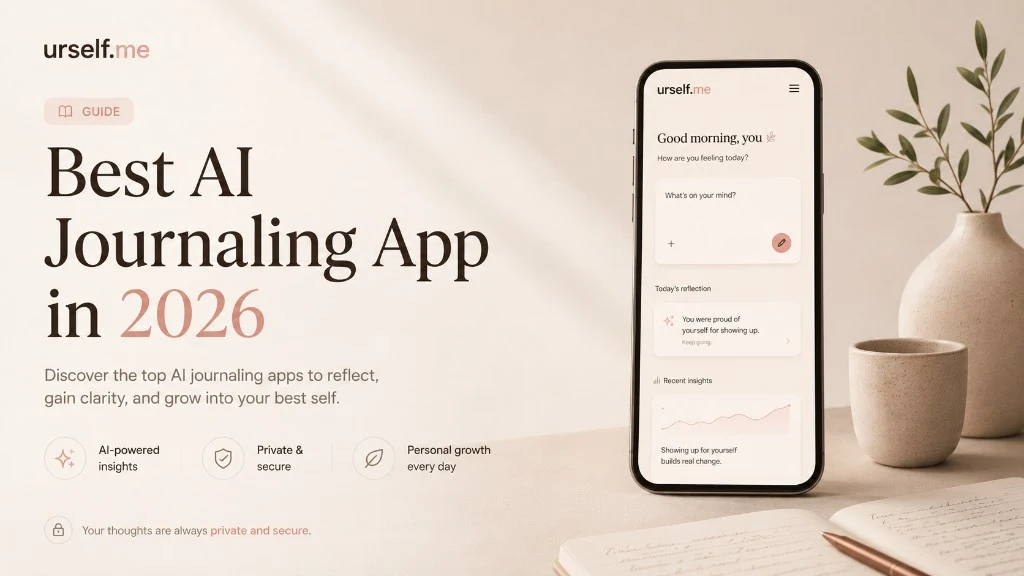
If you searched for the best AI personal growth app in 2026, you are probably not looking for another generic chatbot. You want an AI that learns you — your personality, your goals, your patterns — and helps you think through decisions with clarity. That is what the best AI apps are evolving toward: a personality-based AI secondary self, not a blank-slate assistant.
This guide breaks down what people really mean when they search for personal growth AI, how it differs from ChatGPT, what features matter, and how an AI that improves over time helps you decide.
What people mean when they search "best AI app for personal growth"
Most searches fall into three buckets:
- Discovery — "What is an AI secondary self?" You want an AI built around you, not a tool for random questions.
- Comparison — "Is this better than ChatGPT for my life?" You want a ChatGPT alternative focused on personal growth and decision-making.
- Features — "Can AI learn my personality?" You want AI mood tracking, life goals, and memory that deepens over time.
The best AI personal growth app in 2026 is not the one with the flashiest model. It is the one that builds a continuous picture of you — personality, daily check-ins, goals, and conversation memory — so every decision feels grounded in who you actually are.
Personal growth AI vs generic AI chatbot (ChatGPT)
ChatGPT is built to answer almost anything. That is powerful for research, writing, and coding. It is weaker for personal decision-making because:
- Each chat starts fresh unless you manually re-explain your context
- It speaks as an assistant, not as a version of you
- It has no built-in AI personality assessment, mood tracking, or life goals
- It cannot act as a subconscious mirror for how you think
An AI secondary self like Urself AI takes the opposite approach: one continuous conversation shaped by your onboarding, your 16 personality types result, your daily check-ins, and your goals. It is AI that learns you — not general-purpose software.
What to look for: AI personality, memory, privacy, mood tracking
When comparing the best AI apps for personal growth, prioritize these features:
AI personality assessment
A strong onboarding gives your AI a stable foundation. Urself AI places you among 16 personality types across four categories, then generates a rich AI summary — context for how you tend to think and decide.
AI memory layers
The best AI remembers without overwhelming you. Look for structured memory: identity, recurring themes, recent mood patterns, and recent conversation context — not hundreds of disconnected chat threads.
AI mood tracking
Daily mood check-ins turn abstract decisions into concrete context. When your AI conversation can reference how you felt last week, insights become sharper.
Life goals AI integration
Career, health, financial, and personal goals should inform your AI — not live in a separate app you never open.
Private AI design
Your inner life is not content for a social feed. Choose private AI with no public profile, no leaderboards, and clear privacy policy.
How AI builds self-awareness and better decisions over time
Personal growth AI is not about asking more questions. It is about noticing patterns: what lifts your mood, what drains it, which goals stay active, which thoughts repeat.
An AI that learns you connects today's conversation to last month's trend. One intentional daily check-in — mood, wins, lessons, thoughts — compounds into a portrait your AI draws on. That is how your secondary self becomes a subconscious mirror for decision-making.
Why an AI secondary self beats a generic chatbot
Generic AI tools answer and forget. An AI secondary self:
- Speaks in first person about your life only
- Draws on your check-ins and goals automatically
- Keeps one thread from day one — no "new chat" amnesia
- Gets better at predicting how you think over time
- Helps you finish thoughts you have not fully formed yet
If you have ever wished you could talk through a decision with a wiser version of yourself, that is what personal growth AI is for.
Private AI vs public social platforms
Social platforms optimize for engagement. Private AI optimizes for clarity and decisions. No comparisons. No performative posting. Your AI should feel like a room only you enter — with a presence that knows the full story.
Urself AI is explicitly not therapy, not a task manager, and not a social network. It is AI for personal growth and decision-making.
How to start building your AI secondary self in 2026
- Start small — one mood check-in or one conversation beats waiting for the perfect moment.
- Let AI ask — your secondary self can surface what you would avoid thinking about alone.
- Link goals — note one career, health, finance, or personal goal each week.
- Review patterns monthly — mood trends matter more than single bad days.
- Stay private — choose AI that treats your data as confidential.
For more answers, see our AI personal growth FAQ on the homepage.
FAQ
Is personal growth AI the same as therapy?
No. Urself AI is AI for personal growth and decision-making — not clinical care. If you need professional support, consult a qualified provider.
Can I use Urself AI as a ChatGPT alternative for personal decisions?
Yes — if your goal is ongoing growth with AI memory, mood tracking, and goals. For general knowledge questions, use a general AI assistant instead.
Is the best AI personal growth app free?
Many apps, including Urself AI, let you start free. Create your profile, complete the AI personality assessment, and begin building your secondary self before choosing optional paid AI chat plans.
Ready for an AI that learns you and helps you decide? Try Urself AI free — AI personal growth app and start building your AI secondary self today.